
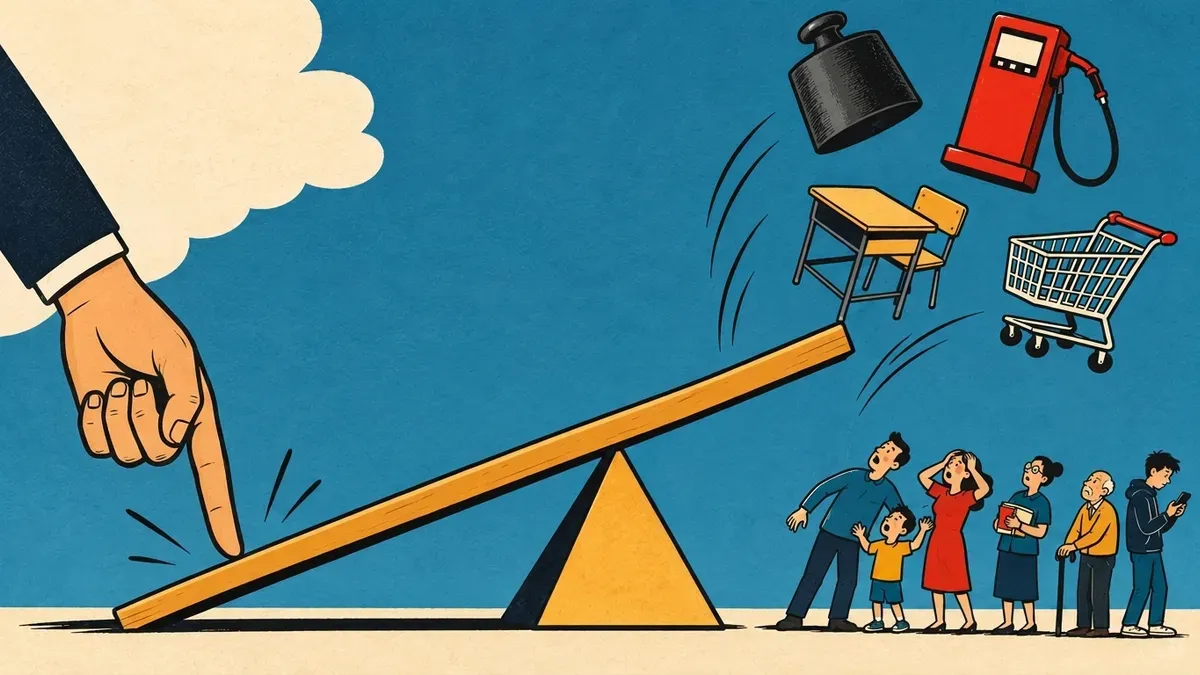
On Monday 9 November, diesel in Italy cost 2.232 euros a litre on average,1 a third more than in January.2 In the months in between, the United States and Israel attacked Iran and the Strait of Hormuz was closed.3 By October, Italian inflation had climbed to 5.4%, pushed up mostly by energy.4
Whoever decided to start that war, clearly, doesn’t have to pay for the damage it did. Nassim Taleb explains this very well in Skin in the Game: on one side there’s the person who makes the decision, on the other the person who lives with the consequences.5 When they aren’t the same person, you have an asymmetry. Nearly four thousand years ago the Code of Hammurabi dealt with it in a brutally symmetrical way: if a house fell down and killed its owner, the builder was put to death as well.6
An asymmetry isn’t quite a bottleneck, which is what this column is usually about. A bottleneck is a narrow point that can choke results. An asymmetry is a lever: the person deciding barely has to push to lift tons, and the tons land on someone else.
Who decides and who pays
Take an example close to home. Italy’s budget law, which is being debated right now, cuts schools, pensions and a public health service that, once you allow for inflation, is losing money and shrinking as a share of GDP.78 Sure, not everyone in politics grew up comfortable. But it’s hard to believe that someone who has really struggled would sign off on cuts that hit exactly the people who are struggling. More likely, whoever signs them has never been in those shoes: on a very high salary, the weekly shop getting dearer won’t cost you any sleep, and prescription charges don’t matter much if you go private anyway. And there’s our asymmetry.
None of this is new, but it’s a loop that keeps feeding itself. If you’re shielded from the consequences, you have no real sense of the hardship, and since you never pay for your mistakes, you don’t see them as problems that need fixing. In practice, what gets rewarded is exactly what harms society, the society that’s supposed to be in charge. It’s like a child who gets away with everything: he grows up sure that nothing he does will come back to him, and there go the brakes. He just keeps drifting further from the life most people actually live.
In Bari, in southern Italy, we’ve been watching this for months with the roadworks for the Bus Rapid Transit (BRT), the electric bus system that runs on dedicated lanes. The project was approved in 2023 by Antonio Decaro’s city government9 and is now being carried through by Vito Leccese’s. Meanwhile, according to the residents’ committee, hundreds of parking spaces have vanished and private car parks have got more expensive.10 The bill, in time, money and stress, has landed on residents, and nobody is answering for it.
What hurts, teaches
There’s something that makes an asymmetry worse than just unfair. The Greeks had a saying, pathemata mathemata: what hurts you teaches you. A deeper, better-read cousin of “no pain, no gain”. If you push the risk onto others, you don’t just dodge the bill, you dodge the lesson too. It isn’t that you make fewer mistakes. You simply stop noticing them, and you keep deciding the same way.
I came at this from another angle in The first rung: you learn a trade by getting real projects wrong, and if somebody else always pays for your mistakes, the trade never sinks in. That’s as true for someone in their first job as for someone making decisions for millions. When the consequences never come back to you, you don’t learn. You just repeat.
Those who don’t use it complicate it
Anyone who works in software knows this side effect well. Things designed by people who don’t use them day to day keep getting more complicated, until they fall apart. The business software built by someone who never has to use it, the form with thirty fields when more than half could be worked out from the others, the procedure written by none of the people who use it.
Where does the difference show? If you use a tool every day, you simplify it, because every pointless step costs you time and patience. If you design it from the outside, you see it differently, less practically, and you tend to add things, because every addition feels like one more safeguard. I wrote about this in Documenting is not about understanding, it is about being able to choose. The cost of all that complexity falls on whoever’s on the other side of the form.
Talk is cheap
Another (un)fortunate kind of asymmetry: saying versus doing. Talk keeps getting cheaper. A post, a video, a course recorded once and sold a thousand times. With AI, producing an opinion costs next to nothing, and a language model is the extreme case: it risks nothing and repeats sources that were already repeating someone else. And the people selling the models? In the United States, some families have sued chatbot makers, accusing them of contributing to their children’s suicides.11 Some of those cases were settled on confidential terms:12 when the bill does come, nobody gets to see it.
But if the person talking has never actually done the thing, and just repeats what others already repeated, mistakes and all, what are they really teaching? How to talk, not how to do what they claim to know. What you mostly learn from a professor is how to be a professor. It’s the old argument between theory and practice, which are really one thing, told by people who don’t practise. The same goes for people selling courses: what they really know how to do is sell courses. The real product is the sale, not the content. In other words, “those who can’t, teach” is back in fashion.
Then there’s a mistake we’ve all made, me included: treating a good speaker as proof. Someone eloquent can come across as competent, but effortless talk on its own proves nothing. Economists call this a costly signal: a signal is believable when it’s expensive to produce, and more expensive for people who don’t have the quality they’re claiming.13 Finished work with your name on it is a signal. A persuasive speech isn’t.
Being wrong, on the other hand, hasn’t got any cheaper. The responsibility stays with whoever acts on the advice: the person who switches supplier, reorganises their work, puts in their time and savings.
Where the test falls short
Even looking at what someone has put on the line doesn’t settle everything. People who really did take risks only know their own road, and the ones who made it tend to tell it as the only road there is: those who made the same choices and failed don’t usually write books or sell courses. I wrote about this mistake when I shut down GoSolo: the people who made it aren’t a representative sample. It’s survivorship bias.
The second filter is time. Advice that has held up for centuries has been tested far more than advice that came out last week, however much better the new stuff is told. That doesn’t make the new stuff wrong. It just hasn’t proved itself yet.
What to look at
One way out is to stop listening to the story and look at the person’s track record instead: what choices they’ve made, what they own, what they’ve put on the line. That’s what they actually know. The rest is propaganda, however well delivered. That goes for everyone, including whoever writes this column.
When someone tells us what to do, how often do we ask where they’re coming from? What have they actually done themselves, and how much would they lose if they turned out to be wrong?
Footnotes
-
Fuel price observatory of the Italian Ministry of Enterprises and Made in Italy, national average for self-service diesel on 9 November 2026, reported by LentePubblica. https://lentepubblica.it/?p=439871 ↩
-
Monthly average price of diesel in January 2026: 1.6597 euros a litre. Rivaluta.it, historical series of diesel prices. https://www.rivaluta.it/prezzi/p20083171217292348.htm ↩
-
Il Sole 24 Ore, L’impatto della guerra in Iran: the military operation by the United States and Israel began on 28 February 2026. https://lab24.ilsole24ore.com/guerra-iran-impatto-energia-gas-economia/ ↩
-
Istat, Prezzi al consumo (dati provvisori), ottobre 2026, release of 30 October 2026. https://www.istat.it/comunicato-stampa/prezzi-al-consumo-dati-provvisori-ottobre-2026/ ↩
-
N. N. Taleb, Skin in the Game. Hidden Asymmetries in Daily Life, Random House, 2018. The book is in my library. ↩
-
Code of Hammurabi, law 229. ↩
-
AGI, 1 November 2026, on the cuts to school staff and the tighter indexation of pensions in the 2027-2029 budget. https://www.agi.it/economia/news/2026-11-01/manovra-tagli-scuola-pensioni—39807614/ ↩
-
Fondazione Gimbe on the 2027 budget: the ratio between the national health fund and GDP goes from 6.14% in 2026 to 6.11% in 2027, then below 6%. Reported by Teleborsa on 2 November 2026. https://www.teleborsa.it/News/2026/11/02/manovra-gimbe-per-sanita-risorse-insufficienti-123.html ↩
-
Ferrovie.it, Novità per Bari: arriva il Bus Rapid Transit, 6 October 2023, with mayor Antonio Decaro’s statement on the approval of the project. https://www.ferrovie.it/portale/articoli/14106/pdf ↩
-
Bari e…, Progetto BRT a Bari: troppi dubbi e nodi irrisolti, statement by the No BRT citizens’ committee of Municipio 2. The parking estimates are the committee’s. https://www.bari-e.it/in-attualita/progetto-brt-a-bari-troppi-dubbi-e-nodi-irrisolti/ ↩
-
Raine v. OpenAI, filed in August 2025 in the Superior Court of California, is still ongoing; OpenAI denies responsibility. https://letsdatascience.com/news/maria-raine-presses-openai-for-answers-in-chatgpt-wrongful-d-183807ba ↩
-
Associated Press, Google and chatbot maker Character to settle lawsuit alleging chatbot pushed teen to suicide, January 2026: the terms of the settlements were not disclosed. https://wtop.com/national/2026/01/google-and-chatbot-maker-character-to-settle-lawsuit-alleging-chatbot-pushed-teen-to-suicide/ ↩
-
M. Spence, Job Market Signaling, The Quarterly Journal of Economics, 87(3), 1973. ↩