Roughly how it goes
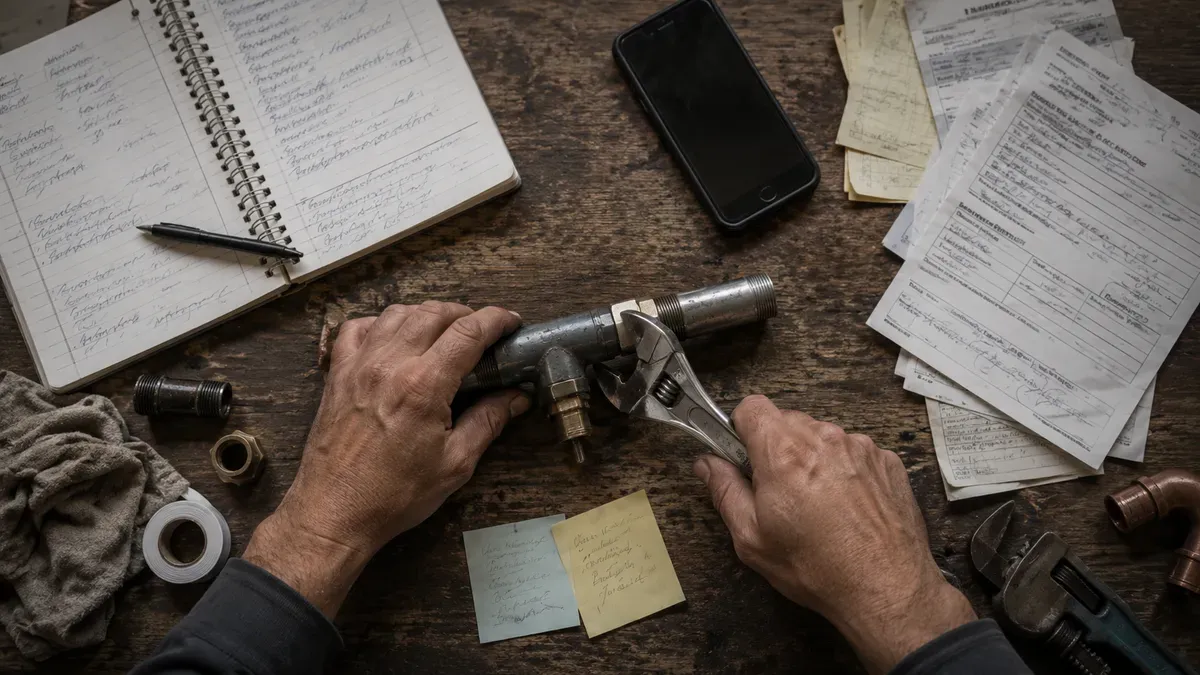
A plumber who is good at his trade has the phone ringing while his hands are inside a wall. He can’t answer. At the end of the day he finds six missed calls, four messages and two quote requests with no details. He calls three of them back, the others he notes down somewhere. The next evening he remembers that one of them needed an answer by yesterday.
On the other side there is the person who called. He phones on Monday, tries again on Wednesday, writes on Friday. The following week the answer finally arrives: I can’t fit you in before October. It is a perfectly legitimate answer, but it came ten days after the question. In those ten days neither of them gained anything: one kept chasing an answer, the other kept piling up requests he would sooner or later have to answer. Frustrating for both sides.
Two trades at once
There is no shortage of work. The problem is that someone who works with his hands can’t answer the phone, understand a request, book an appointment and keep working.
When he tries, which is what happens almost every time, everything comes out worse. You answer with your hands full and you only half listen, you give an approximate date that will have to be corrected later, you forget to ask the one thing you needed to know. Meanwhile you have lost the thread of the job you were doing and it takes a few minutes to pick it up again. This is not a matter of goodwill. These are two activities that spoil each other every time they meet, and over the course of a day they meet quite a few times.
And behind every request there is not a single answer. There is working out what it is about, scheduling the site visit, asking for the measurement that was not in the message, deciding whether the job is worth taking and when it can be done, remembering to call Tuesday’s contact back. Taken one at a time they are matters of a few minutes. Put together they become almost a second trade, one that nobody ever put in the diary and that ends up being done in the gaps left by the first.
What we count
The hours we know how to count are other hours. The Confederazione Nazionale dell’Artigianato e della Piccola e Media Impresa (CNA), in the sixth report of its Osservatorio Burocrazia, counts 313 a year for a small business, and those are the ones spent on red tape. They have a name, a deadline and often a fee too, the accountant’s.
It is normal to start there when you are looking for a way to save time. Administrative work is visible: it has dates, it produces documents, it arrives by registered mail. The point is that it is also the part we have largely already handed to someone else. The accountant is there, the payroll consultant is there, and around that kind of problem there is an entire market busy selling us a solution. Nobody has delegated the work of keeping up with incoming requests. It has stayed on the owner’s shoulders, spread through the day in two-minute pieces, and there is nobody phoning to remind him about it.
Nobody invoices the time spent sorting requests and it shows up nowhere. It has no line of its own in the accounts and often none in the head of the person spending it. It is simply that by the end of the day there is time missing, and it is not always clear where it went.
Electronic invoicing
Then there is a comparison that helps explain the rest. Since 2019 electronic invoicing has been mandatory, and Italy was the first European country to introduce it across the board. We did not all learn it out of a passion for digital: we learned it because, at a certain point, you needed it in order to work.
In the same country, according to Istat, a little more than one business in five keeps track of customers and their requests with a piece of software. And Istat only counts businesses with at least ten employees: most of the smaller operations do not even enter that statistic.
These are not necessarily two different kinds of business owner. It can be the same person. On one side he learned to use a new tool because he did not have much choice; on the other he goes on handling calls, messages, requests and reminders more or less as he always has. The difference is not necessarily the ability to use technology. It is that in the first case there was a precise moment by which you had to change.
An obligation removes the alternative
An obligation does one thing, and does it well: it sets a day after which the old way of working stops working. It convinces nobody and explains nothing, it simply removes the alternative. From the first of January 2019 the invoice pad was no use any more, and anyone who had not got set up was not getting paid. The way we handle requests has nothing of the sort. It can stay identical for five years without anything happening, because there is no day on which it falls due and nobody is left idle for having put it off. It keeps costing, but it does not send a reminder.
Maybe that is exactly the point. We fixed first the things that had a deadline, an obligation or an obvious urgency. That does not necessarily mean digital culture is missing, and often the money is not missing either. What is missing is a reason strong enough to interrupt the way you have always worked and take on the cost, even just the mental cost, of learning a new one.
The work we repeat every day inside the business has no delivery date. Nobody forces us to stop on a Friday afternoon and ask why we answered the same question five times, copied out the same piece of information three times, or lost half an hour working out who we were supposed to call back. So we carry on doing it.
The work that has no name
And there is a more mundane reason, which is perhaps the main one: this work has no name. Red tape is called red tape. You can name it in a conversation, you can discuss it with your accountant, you can look it up. The time that passes between a customer’s phone call and the answer he gets is not called anything. It is not a job, it is not a cost item, it is not a subject colleagues talk about. It exists only as separate episodes that seem to have nothing in common with each other: the message I did not answer, the site visit I forgot, the quote redone twice because a measurement was missing.
As long as it stays in that shape it is not a problem, it is ten annoyances. And an annoyance does not get solved, it gets put up with. You are unlikely to look for a better way of doing something you do not know you are doing, and in any case you would not even know where to start looking, because you would not know what words to use.
Repetitive does not always mean automatable
Then there is another step that often gets skipped. Repetitive does not automatically mean automatable. A program can mainly take over the part of the work you could explain clearly to a new hire without having them call you back every five minutes. Saying which areas we work in, gathering the information needed before a site visit, reminding someone that they have to confirm an appointment: these are activities that can follow fairly clear rules. Deciding whether that job is worth taking, whether that customer presents a particular problem or whether that request deserves an exception is something else. That decision stays with whoever knows the trade, and rightly so.
Start from the day that went well
There is an order worth respecting, though, and in practice it is almost always reversed. The software should not invent the way of working, it should arrive afterwards, once the way of working is already clear.
And the starting point is not the day that went badly, it is the one that went well. Every so often a request gets handled properly: you understand straight away what it is about, you ask for the two or three things you need, you give a date and you keep it. When that happens it is worth stopping for a moment and reconstructing what you did and in what order. Usually four or five steps come out, always the same ones, that went well that day by chance.
Written down on a sheet of paper, those steps become the way you answer, and something already changes at that point, because the same thing can also be done by your partner, your son or whoever is in the office on a Saturday morning. Only afterwards does it make sense to look at which of those steps do not require knowing the trade, and they are usually the most boring ones: asking for the missing information, sending the confirmation, reminding about the appointment the day before. Those can be handed to a program. The others stay where they are. Software bought before doing this work imposes a way of doing things decided by somebody else, and it almost always ends up abandoned without anyone saying so.
What gets lost
The part nobody puts in a proposal should be said too. Removing a manual step sometimes means also losing what that step brought out by chance. Someone who answers every phone call personally hears nuances, exceptions and problems that probably would not show up in a form. Automating well therefore means removing the useless work without also removing the information you need in order to decide.
If a law came out tomorrow, with a precise date, requiring every request to be answered within three days, how long would it take us to find a way to organize ourselves?