
A certified email arrives in the inbox of an Italian public office. In Italy it is called PEC, and it carries the legal weight of a registered letter. The person in charge of the records registers it and prints it with all its attachments, often dozens of pages. The folder is carried by hand to the next desk, pushed right up against the first, where a colleague scans it again, registers it again and only then files it. The document goes back into the very system it had just come out of. I saw it happen every day: a few years ago it was standard practice.
Each round trip took about twenty minutes per clerk, so more than forty minutes per document, for all of the office’s mail: dozens of emails a day. On top of that came duplicate data, reams of paper and toner, and cabinets full of printouts of files that already existed in the system at least twice over. Nobody saw it as a cost, because it was spread thin across every working day. The office paid for it and, in the end, so did the taxpayers.
The road was already paved
Italian law had required public bodies to keep an electronic records register since 2004, and handling the mail took a few clicks. The software was there and the staff had been properly trained, so where was the problem?
Before, mail was made of paper and reached the right desk by passing from hand to hand. With certified email there were no sheets left to pass on, so people recreated them by printing. The software had removed the reason for that step, at least on paper, but it was the people using it who had to live with the change. So they kept making the gesture closest to the old one. In fact, when they couldn’t repeat every step, they came close to panic.
This is not a story about public administration alone. When factories moved from steam to electricity, for decades they swapped the engine and left the shop floor as it was, laid out around the old central engine. The gains arrived only when someone redesigned the work around the new motor.1
The tool just sits there
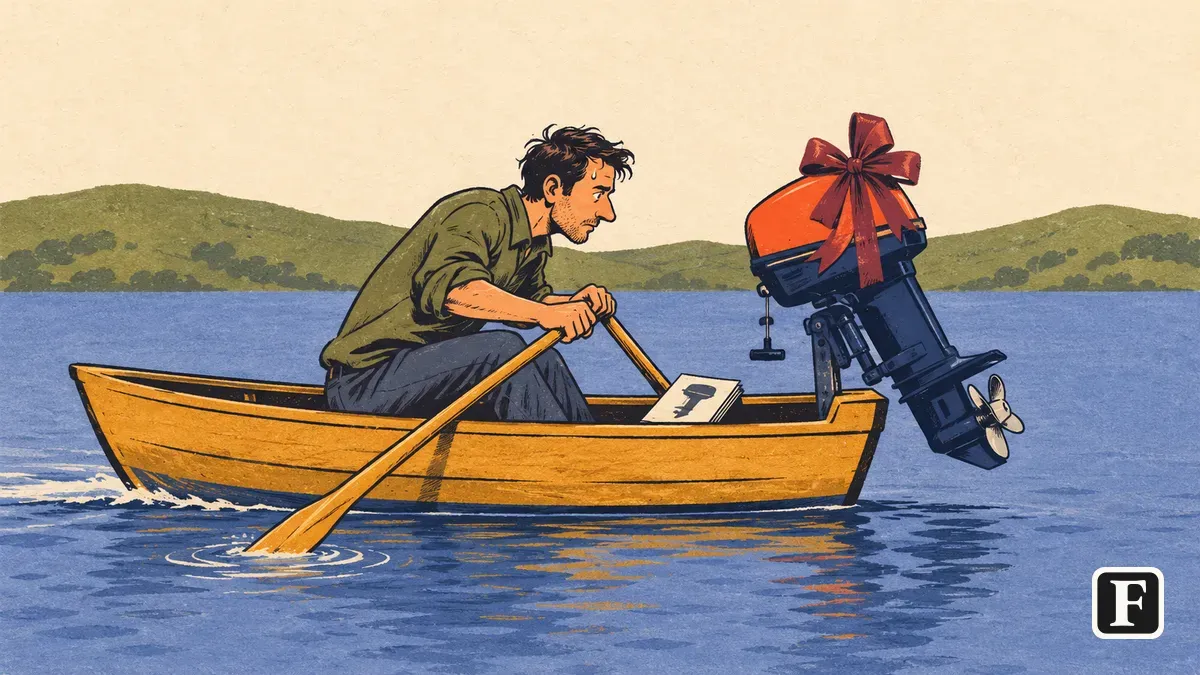
The training explained what to do, and yet it took years for the way of working to really change. Tools, whether they are products, consulting or simply a different way of dealing with people, however better and newer they may be, don’t work on their own: someone has to engage with them, and the work, mental work above all, stays with whoever uses them. A new habit takes time and a lot of repetition, and until it becomes automatic, the first difficulty sends us back to the old behaviour. Anyone who has quit smoking knows what the first thought is when things get hard.
The old gesture has an advantage that is hard to beat: it costs nothing, because it takes no thought. The new one asks for attention at every step at first, and the benefit comes only after many repetitions. Whoever has to change pays straight away, while the benefit remains a future unknown. That effort is a price that appears on no quote, and it is paid in full by whoever has to change.
Better for whom
So it is not enough for a tool to be better, just as there may be no such thing as “better” in absolute terms. Sellers judge a product by what it does. Buyers judge it by what they would have to leave behind: their habits, the time already invested, the comfort of knowing how things are done. Each side overvalues its own part, and the distance between the two judgements explains why so many better products never get adopted.2
If every offer leaves the customer with all the effort of changing, offers end up looking alike and the cheapest one wins. Anyone who doesn’t want to compete on price alone has to take that effort on: anticipate needs, first of all those of whoever pays, who is not always the one who will use the tool, and fit the offer to the context of whoever has to adopt it. The habits, the time and the limits of the people who will have to change are part of the seller’s job, not the customer’s problem.
Taking effort away
The American entrepreneur Alex Hormozi has built a whole method on this, from the offer to the sale. In $100M Offers he describes perceived value as a fraction.3 On top are the outcome the customer wants and how likely they think they are to get it. Below are the time they have to wait and the effort and sacrifice asked of them. Value can grow by promising more, or by taking effort away from the buyer. For Hormozi it is mainly the second that decides what an offer is worth, even though it is the hardest point to work on.
His suggestion is to list every obstacle between the customer and the result, and to find a solution for each one before the customer runs into it. It rarely works the first time: it takes many attempts and an obsessive search for what to improve at every round.
In the office with the printed emails, nobody had done that work. The software had arrived with instructions and training, and the whole effort of changing had been left to the people keeping the records.
How much effort do we leave to the customer in what we offer?
Bibliography
Footnotes
-
P. A. David, The Dynamo and the Computer: An Historical Perspective on the Modern Productivity Paradox, American Economic Review, 80(2), 355–361, 1990. ↩
-
J. T. Gourville, Eager Sellers and Stony Buyers: Understanding the Psychology of New-Product Adoption, Harvard Business Review, June 2006. https://store.hbr.org/product/eager-sellers-and-stony-buyers-understanding-the-psychology-of-new-product-adoption/r0606f ↩
-
A. Hormozi, $100M Offers: How to Make Offers So Good People Feel Stupid Saying No, 2021. ↩